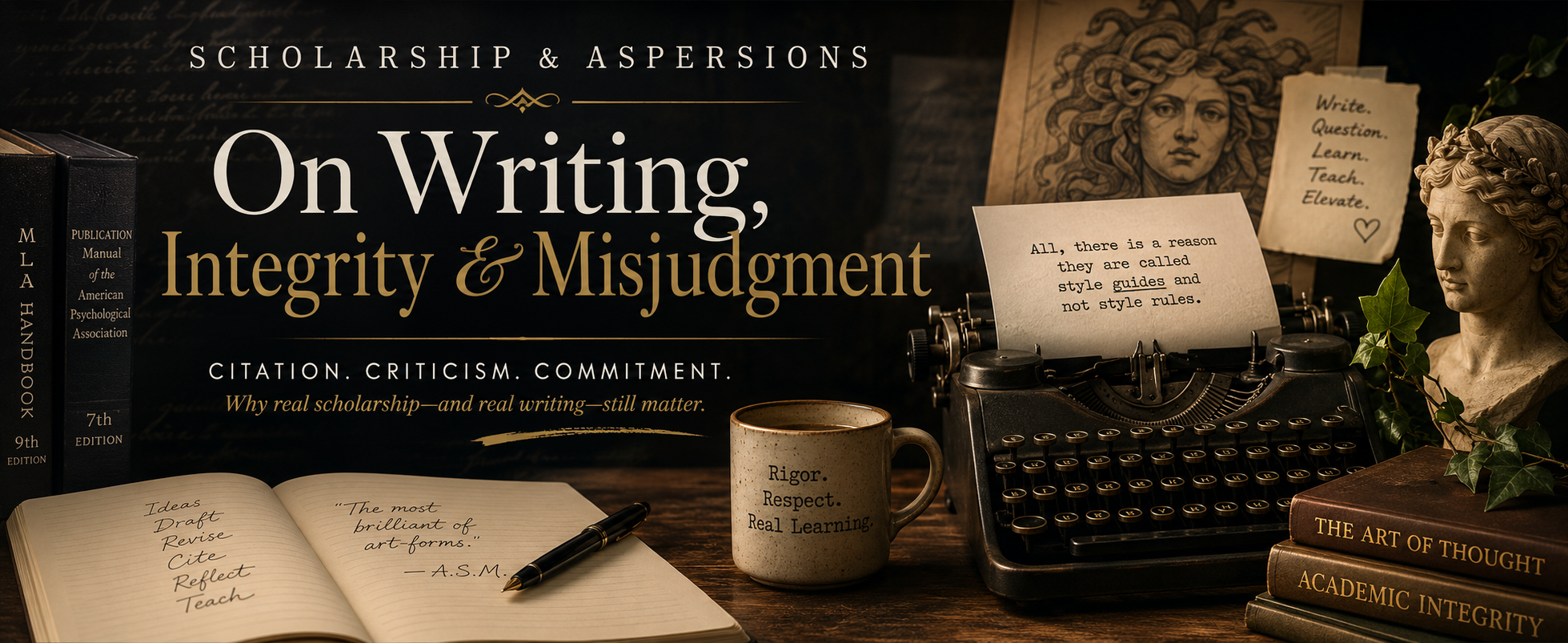
Today, it has come to my attention just how wildly misunderstood citation style is and the purpose of academic writing to the current generation of those pursuing higher education. Someone forwarded me a critic comment that my work is “AI-generated” writing. I find this laughable for many reasons. Allow me to illuminate those reasons:
I have been teaching Academic Writing and citation style for 30 years (started as an undergrad when I was asked by the then most-rigorous professor on campus to be his Writing Assistant, which was something he never did. He was the kind of man who handed back your paper if your margins were off by more than 1/8” and yet found my writing so compelling, he conscripted me as a Freshman). I’ve been through now 7 editions of MLA and 5 of APA. I know my manuals of style so well that I have to adapt when I publish in peer-reviewed journals (which I do fairly regularly). So why is this laughable? Because some recent critics’ ability to effectively research is so stricken that they don’t have the wherewithal to corroborate my own authority—I’m all over the web. In fact, a piece I wrote on the Berlin Wall when I was 19 in an experimental nonfiction class was cited in a book on the subject, and all of this is so easily found that it takes merely the ability to spell my name to strike a vein of gold. Yet, many critics who claim they are such magnificent researchers fail to find these things out for themselves and instead operate on rumor and conjecture. All, there is a reason they are called style guides and not style rules. Your instructors, publishers, journal-editors, and institutions have the ability to add-on to your citation style needs and, in the age of AI, to most certainly require more verifiable forms of reference. In fact, just today I found a person at one of the many institutions where I provide educational support had clearly used AI and, fortunately, had the integrity to own up. Not all do this, but owning up is key. Plagiarism comes in MANY forms.
I’m a professional writer with both an undergraduate and graduate degree in Creative Writing (this is terminal in my field, meaning an MFA is the highest you can technically achieve in this domain). I have no need to use artificial tools to write anything. In fact, my last peer-reviewed article (in Advances in Online Education, by Henry Stewart—a scholarly journal which uses Vancouver Style, one I myself had to learn, no less) is literally about the slippery slope of AI in terms of academic integrity and literacy. You can actually read it for free with a subscription (no cost) to Henry Stewart. I linked it for you. The only thing for which I use AI is to come up with compelling lesson plans for my youngest client population because I freely admit I’m not as acutely aware of what engages the current teen-generation in terms of learning, so I do what any academic would do: I research it and apply what I learn from that research. Yes, I do use AI-generated art occasionally (I was selected for a presidential research grant for applications of AI-use in academia which came with some required user-testing of AI-generation, so I used it to make some art (like the Medusa image you see below), but I don’t use it to write. In fact, the idea makes me sad. Writing for me is the most brilliant of art-forms. I’d rather write than do anything else. The idea of using a machine to write for me is just depressing. I’d rather have a machine do my chores so I can do the writing, thanks. And yet, here you have the accusation. That my work is AI-generated. Interestingly, this came up with some colleagues over our shared love of the em-dash (do you, gentle reader, know what an em-dash is? If so, join me in this chortle). I’ve used this elegant, T.S. Eliot-ian style of punctuation—this playwright’s aside affectation for grammatical mechanic—since I was a high schooler, and yet now, thanks to AI’s prolific use of it, my own natural use of this most lovely of punctuation-marks casts undue aspersions on the grit of my inkwell. Le sigh.
I’m a lifelong learner with a commitment to my disciplines and my clients: Yes, I do reuse feedback as I often encounter the same errors or trip-hazards in one piece of writing to the next (and like many instructors, have learned to store my feedback in a digital sticky-note for ready re-use), but I do not use anything but my own mind to produce responses to my learners. In fact, I’ve taken hours upon hours to produce an original and commercial-free (meaning NOT monetized) YouTube site @ProfessorReboot just to create and share learning videos for my clients to be as successful academics as they can be. Why would I spend so much time in this act of charity if I wasn’t committed to the art of actual learning? Learning is one of the most fantastic things a person can do with her time and we do not learn in a vacuum or when we are comfortable. We learn when we are pushed, nudged, needled, and reminded that not all things come in a shiny wrapper. Most of all, learning in higher education is accredited, meaning that each class you take is rooted in credit-bearing time-spent. When a person comes to a proficiency course expecting to cruise through 3-credits (145 hours if taken in a “traditional” methodology, mind you) in just 3 days, they often are surprised to learn I genuinely care that they learn something from me. I don’t believe in skating. I believe in rigor, tough love, gentle encouragement, reminders, setting the bar high because when you reach it—and you will reach it—you will know yourself to be the rock-star you truly are because you weren’t given a hand-out. You truly earned your way through something tough, high-stakes, and devoted. No pandering. You were held to a standard—and you met it. Some of my clients get this. There is no greater feeling for me, as a professional, than the moment a client has her “AHA!” and comments a note of gratitude or leaves an audio file that says “At first, I was annoyed, but then I realized I was actually learning something…” I love that. Good. I hope that for ALL my clients. Always. And I try very, very hard to help them achieve. I genuinely care about you all. You are, after all, the next generation that will push the cart up the hill. I want you to know just how the wheels stick in winter or where the asphalt is crumbling when you trudge up the hill… I want to help you. I hope I succeed in that.
Lastly, we are ALL required to prove ourselves in this age. Personal statements are not enough. In fact, that’s exactly why I’ve included two direct links in this message. It’s not enough even for me to baldly state my claims about my credibility or authority as an academic. I have to show you I mean what I say. Of course, you could also do the research yourself. :) So if you have a personal history that supports your claims, blessed be. Truly. I applaud you. But you will still need to cite something to validate any claims you make about that history because, unless another scholar can drive to your house and verify your family photo album truly contains the stories you claimed in your reflection, then the work of scholarship has not yet been completed. That’s a tongue-in-cheek statement, mind you—no scholar should have to drive to your house because no piece of writing should have to be supported by a human standing above it declaring “This is what I meant by…” or “See? This happened to me and I can show you…” Why? Because writing is a record—not a drama—and that writing is meant to live a life without us standing there to explain it to everyone. If the writing cannot do the explaining on its own (without me or you there to prove it to be true), then it’s incomplete (at least, as an academic record. As a journal? Sure. But journals aren’t typically meant for the eyes of the public). So if you’re writing about yourself and you are asked to support claims you make about what are or are not best practices, remember that this is not someone trying to tell you that you are wrong. This is someone trying to help you be a better record-creator. In this age, pretty much everything we write is a record (for better or worse). There is writing I created in my youth I’d love to see scrubbed from the annals, but they shall carry on as long as there are people seeking me out. So it goes. So it goes. And so I go on. You carry on, too, my reader.
Oh, and one last thing—remember this: We of the writing world? We are experts at diction. We know how you write. If you truly wish to be anonymous? Consider having someone else write for you, because if you write anything yourself, your expert-writing friends will easily be able to pick you out (by name and memory) from the simple stretch of words you use to carry your message. Anonymity is not real. But experts are. Verifying experts is a process that, too, is real. Verify me. I stand by my work. And letters of recommendation? They are a privilege (not an entitlement). When you want one, be sure to ask only those you know will write you a good one.
Remember that undergrad professor for whom I was a Writing Assistant? It was he who taught me that you should always ask, “Will you write me a positive letter of recommendation, please?” There is a keyword there. And, of course, when one writes you such a letter, he also taught me to send a thank you card. I’m glad he taught me that. It has carried me very far in life. I hope it does the same for you, readers.
My next post will be less academic-y and more spiritual or fantastical. The book I’m working on now is, after all, Romantasy (supernatural fantasy with a romance-thriller edge). More soon, friends. Happy days ahead!
And to my clients, know this: I believe in you. I really, really do. Why else would I take so much time to try to teach you anything at all? After all, if I send you back with a revision, am I not just making more work for myself that I could just as easily save myself if, say, I didn’t actually care that you do get something out of your experience? That is, if I didn’t care, I could just say “good job” and be done with it, collect a paycheck, and move on. But I don’t do that, do I? I give you real, tangible, usable feedback with free-resources to support you that I’ve gone so far as to make myself for you. Be the critical thinkers I know you are: Why bother to do a thing like that?
Be well. Stay strong. Be true to your ethics. I will do the same. Peace.