The Fast Track Leads to the Empty Hand
by Araminta Star Matthews
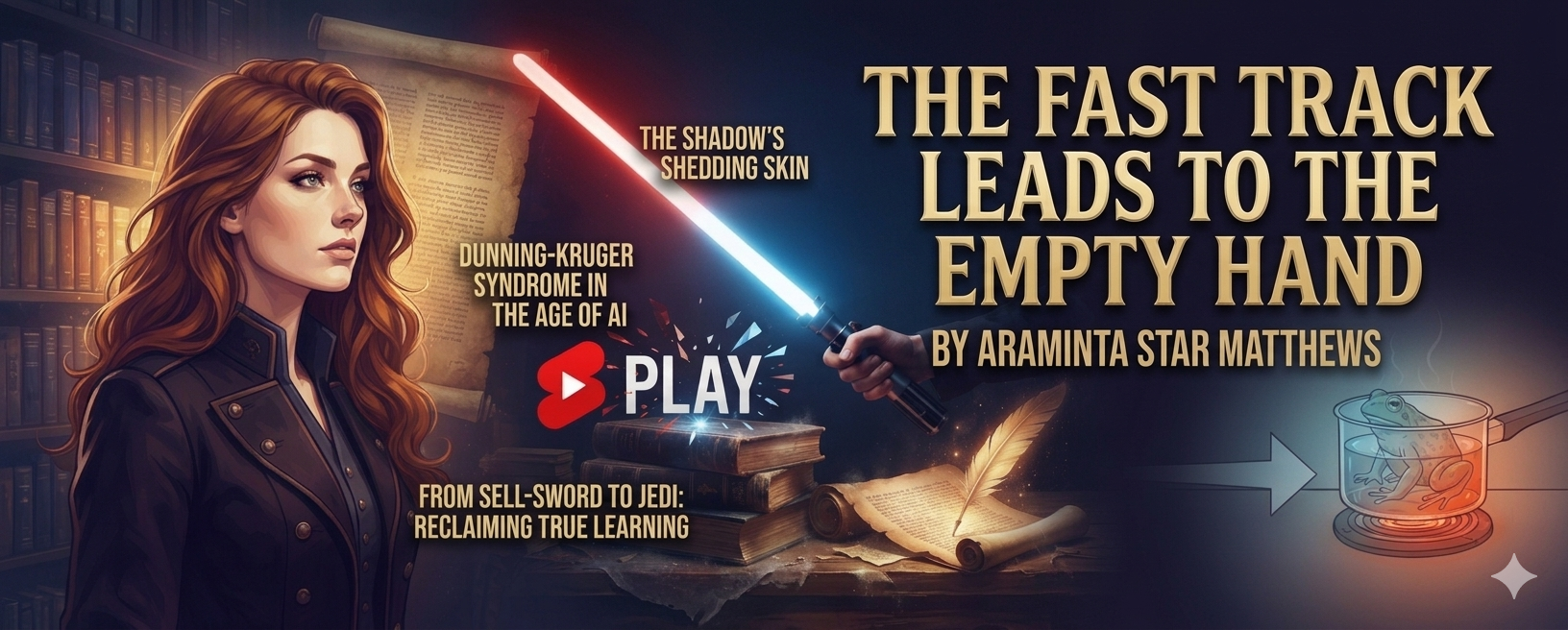
There is a controversy in the world that is astonishingly surprising and ironic. It seems to have emerged in recent times when the world’s Dunning Kruger syndrome reinforced its erroneous self-position that it was, in fact, a great educator! And all we need to do to teach someone is give them a shoddy YouTube short made by a who-knows-who[m] with a blog post by AI and huzzah! You’ve taught someone something!
Because honestly, what could possibly be more controversial in 2026 than getting an education?
Attack What We Think We Know:
The attack on learning was a boiling potted frog situation. I Cassandra-predicted it a few years ago when I saw the decline in student work and the increase in shortcuts. I get it. As an early, gifted writer, I did not always use my writing powers for the work of the Jedi. Occasionally my pen-saber glowed red as the Dark Side pulled me to use my gift for less than the good of all. A sell-sword, as it were, I would absorb in those pre-nanite days the entirety of a bookshelf of knowledge and regurgitate it for a client because I had been blessed with a skill few had back then: The ability to write in vivid or mimicked diction with exacting grammatical construction and accurate citation style.
My Shadow’s Shedding Skin
Like most Jedi, I had to be lured by the Sith before I could learn that the Jedi’s path is the only true path. As Karl Jung once opined, we have inside of us each both a light-dweller and a shadow-self. The light-dweller is the version of our self we allow the world to see, unmitigated by filters and glitter. The shadow self, though, is that part of our identity that we keep in the dark because we fear that others will push us away if they see that Elephant Man of a being shambling into our space, a part of it all along.
We fear that we’ll be seen as monsters for no other reason than being a shadow just as Joseph Merrick (nicknamed “The Elephant Man” by the circus for which he performed) was seen as a monster for no other crime than being born with deformities. Instead of hiding in an attic, at least, Merrick jaunted his shadow into the light and used it for all its seemingly-monstrous glory to earn money in a desperately poor point of history. And in the process, he also showed the world that the real monster is the person who judges another with only a mirror’s reflection (a surface) to navigate that judgment.
I long ago dropped my fear of shame and let my Shadow fly freely. Shame is a wasted emotion. It weighs us down with the rocks others use to fill our pockets with their ideas about what we should be and how we should behave in order to be loved, accepted, worthy, alive. But the truth is that we are worthy for no other reason than existing. And those rocks? They are not Y[OUR] rocks. They have been placed there by other people and their twisted ideals about who we are meant to be by their standards. I live by my standards. I am my own me: My Shadow and I are sewn together quiet comfortably, Tinkerbell, and I need no mother or child-self to threaten separation (J.M. Barrie’s Peter and Wendy).
You see, my Shadow is as much ME as my light-dwelling self is. They are two sides of the same coin. I cannot have my crown without my emblem. No heads without tails. No light without shadows. And so I know that the truth of myself is not simple: I am more than the surface you see—or better still, I’m more than the surface you think you see. I am a complexity of stardust and seeds swirling within a constant state of I am and I am able to be better’s.
We ALL are.
And this is where education has become so controversial. Somehow, we have come to believe through the echo-chamber cacophony of that phone in our pocket telling us on repeat how smart we is that we have stopped looking for the things that verify those alleged belief structures. We no longer follow the Ladder of Inference down the rungs to figure out exactly why we think it’s smart to hide our tattoos and piercings from potential employers or pretending that our mental health and emotional landscape doesn’t exist so others don’t feel uncomfortable by our, dare I say it (?! ze gasp!), humanity! (duh, duh, duhhhhhhhh).
Anecdotal Fallacy:
No, we walk through the world assuming we know everything we know. After all, I just saw someone shot by a local. Surely my experience means crime is on the rise? (Even if I just happened to be in the wrong place at the wrong time and as one person living amongst tens of thousands, I’m the only one who saw that crime and statistics show crime is actually decreasing). Surely witnessing an action is all I need to create a belief, and a belief is all I need to have a fact, right?
Right? I mean, right?
So no. Not right.
Post Hoc Ergo Propter Hoc Fallacy:
If I happened to give my child a vaccine and four years later she was diagnosed with Autism, then surely that means I gave my child Autism with that vaccine. It couldn’t possibly be the myriad other things that occurred in my child’s life over those four years—the amount of screentime to which she was exposed, the underrepresentation of empathetic life-skill training by a mom (or dad) made absent by her own screentime, a lack of independence-building in the outside world, or perhaps something in the DNA code just waiting to unwind at the right moment in her biological clock. Nope. It has to be the vaccine.
Right? I mean, right?
Post Hoc ergo Propter Hoc, or “After this, therefore because of this” happens when we mix up correlation with causation. We see two things that occur roughly around the same time and because they happen in the similar timeline, we presume that they are causing one another. The reality is, though, that there are a billion correlations that mean nothing at all and causation is much, much harder to prove. Causation, of course, is when we are able to say definitively that a precipitating factor led to another outcome. For example, after years of study, we were able to say definitively that gravity is the outcome of centrifugal force. But correlation says gravity might also be because we have mass, we don’t have feathers, the world turned out not to be flat, the moon gives us a little drag, the sun is magnetic, Venus is a flytrap ;), and who knows what else.
So no. Not right.
Equivocation Fallacy:
And if our country has a document that underpins everything that makes it what it is, then surely anything the Commander-in-Chief of that country does is supported by that document and thus legal and prudent. After all, isn’t the Commander-in-Chief the country-elect? And isn’t that document the document we created? Surely one and the other are the same, then.
Right? I mean, right?
An equivocation fallacy happens when someone uses the same word or phrase with two different meanings in the same argument, making the conclusion seem logical even though the meaning has quietly changed. In plain English, it's like "switching definitions in the middle of the conversation." For example, someone might argue, "The President represents the country. The Constitution is the law of the country. Therefore, whatever the President does must be constitutional." Here, the word country first refers to the nation and its people, then shifts to mean the President himself. Because the meaning changes without notice, the conclusion does not logically follow from the premises. Critical thinking requires that important terms keep the same meaning throughout an argument.
So no. Not right.
Comin’ Round to Put it Back the Way It Outta Be:
The tragedy is that anecdotal logic fallacy, post hoc ergo propter hoc, and equivocation are no longer confined to philosophy classrooms or debate clubs. They are not strictly the domain of the information literacy professor at her podium with her long-armed chalkstick clacking at a Blackboard, nor still are they they domain of the digital professor vetted by nearly 25 years of distance education in its many iterations and trained, as it were, to literally design a digital space that mimics a physical classroom with all its chalkdust and projection. We professors have become scapegoats for libel while students, embolded by their tilted self-belief that their Dunning Kruger is far more valid than 30 years of experience and 10 years of education besides, write scathing reviews about us rife with lies (largely by misrepresentation of fact) and think this is an okay world in which to live.
These logical errors have become a political strategy, a marketing tactic, and, increasingly, a weapon wielded against education itself. Around the world, words are stripped of their shared meanings and repurposed to inflame, distract, or divide. Freedom becomes permission to reject expertise. Research becomes any Internet search that confirms a preexisting opinion.
Critical thinking becomes agreement with one's own ideology, while education is recast as indoctrination whenever it challenges comfortable assumptions. We cannot learn in comfort! Pascal reminds us that all the miseries of humankind exist when we dwell within the comforts of our own chambers and refuse to learn how to be out in the world beyond. When language is untethered from consistent meaning, truth itself becomes negotiable. Citizens who can no longer distinguish evidence from assertion or expertise from popular-opinion become far easier to manipulate. That is not an accidental byproduct of weakening education: It is one of its inevitable consequences.
And we boiling frogs are letting it happen.
Everytime one of our students says, “I just want a fast grade” on that public forum they use to libel their educators, those students are saying silently “because I have no interest in reality and prefer to live in an echochamber in the Matrix.” When we moved from the 120 credit hour degree to the 90-credit hour degree, shaving off the very classes that teach a person to question authority(!) and think for the self (!)—even if that authority is mine own as their educator, a question I would welcomingly embrace with vigor—we are training people to become complacent. We are preparing a populace for the shackles of someone else thinking for them.
Maybe it started when kids stopped reading 1984.
George Orwell warned us of this danger in this book. The Party did not simply forbid certain ideas; it redefined words, erased distinctions, and steadily reduced language itself until independent thought became increasingly difficult. Orwell understood that whomever controls language shapes the boundaries of reason. Education, then, is not merely the transmission of information but the preservation of precise language, intellectual honesty, and the courage to ask whether a word still means what it meant yesterday. When we abandon those disciplines, equivocation ceases to be a logical fallacy and becomes a political instrument. Anecdotal fallacy becomes a weapon for anyone unwilling to look beyond the mirror. And Post Hoc Ergo Propter Hoc becomes the shadow Wendy so willingly sewed back onto Peter’s foot for him, so maternal, so helpful that he didn’t have to face it and had a Helicopter (Pixie Dusted?) Mom ready to do it for him.
So, how do we put it back the way it outta be?
We begin by remembering that education is not the memorization of approved answers.
It is the lifelong discipline of asking better questions.
It is the quiet courage to pause before accepting a claim because it sounds right, feels right, or comes from someone we admire.
It is learning to recognize when words have been switched mid-sentence, when anecdotes masquerade as evidence, when authority pretends to be truth, and when certainty outruns reason.
The greatest threat to any democracy is not disagreement; it is a citizenry that has forgotten how to think with precision, curiosity, and intellectual humility. If we want healthier communities, more resilient institutions, and a future worthy of our children, then we must defend education. We must fight for not merely a system of schools, but as the shared human practice of seeking truth with integrity, even when that truth asks us to change our minds.
Oh, and one last tiny nugget in case this escaped you: Those of us who have trained as serious academics (particularly those of us who live and breathe in the schools of letters, language, rhetoric, and meaning) develop a skill that may surprise even the most wary and weary student. We learn to recognize diction. We hear cadence. We see patterns. Every voice, written or spoken, carries its own rhythm, its own fingerprint, its own particular way of moving through the world. Language reveals us. Not because we are hunting for mistakes or waiting to catch someone in a contradiction, but because words are evidence of thought. They reveal what we value, what we fear, what we understand, and what we have yet to learn. A pseudonym may conceal a name, but it rarely conceals a voice (a diction). The way we construct arguments, the way we frame ideas, the words we choose and the words we avoid? All of these are pieces of the intellectual self we bring into the world. Your language matters because you matter. And it is also the thing that makes your anonymous words less anonymous to we academics.
And that is why I believe in education. Not because I want to control what you think, but because I care enough to help you learn how to think. I care about you because I care about my community. I care about my community because I have people I love who live within it. Perhaps that is circular reasoning of the most beautiful kind: We educate one another because we belong to one another. The goal has never been perfection. The goal has always been growth.
I want a world where we remain curious, where we question responsibly, where we use technology wisely, and where we remember that no tool—no matter how powerful—can replace the uniquely human work of interpretation, creativity, compassion, and connection. AI can generate words, but education teaches us how to decide which words are worth saying. It can produce images, but humanity decides what those images mean. The future does not belong to those who surrender their thinking to machines; it belongs to those who use every tool available while still protecting the imagination, empathy, and intellectual courage that make us human. That is the work of education. That is the work of becoming fully alive.
Scholarship & Aspersions
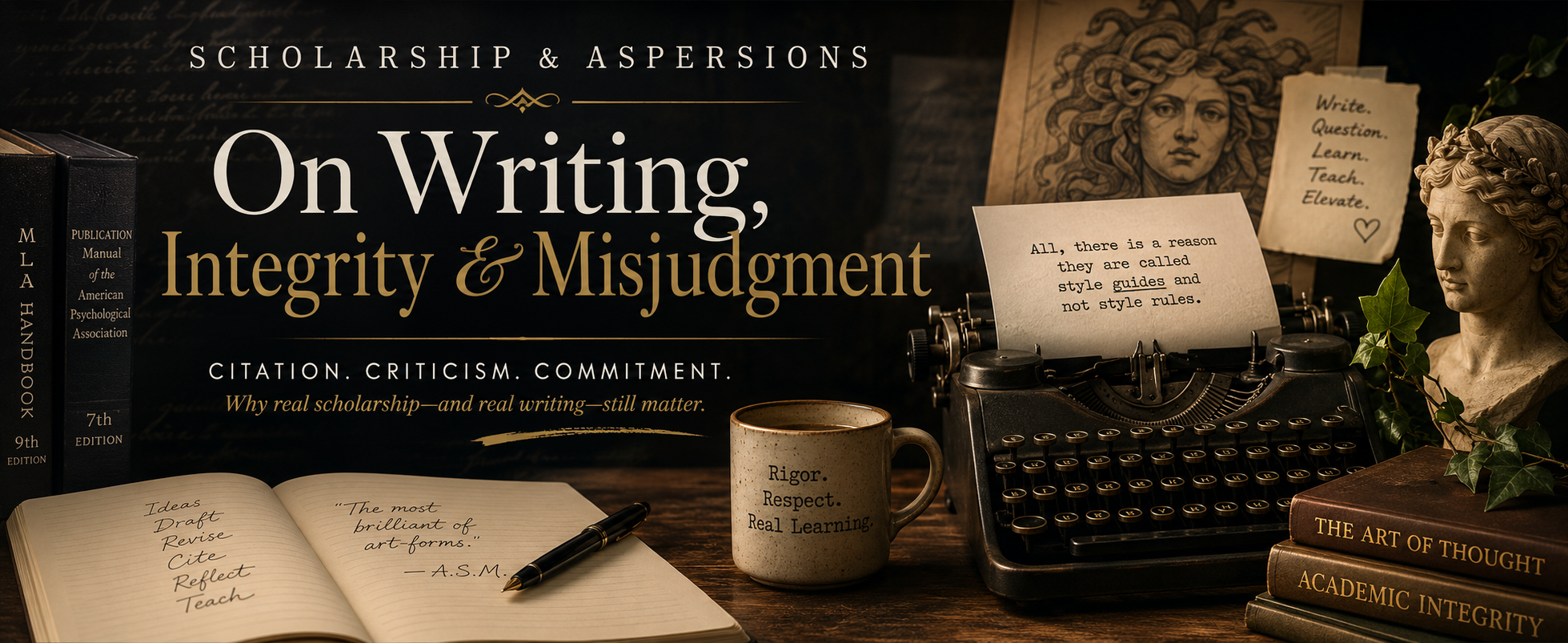
Today, it has come to my attention just how wildly misunderstood citation style is and the purpose of academic writing to the current generation of those pursuing higher education. Someone forwarded me a critic comment that my work is “AI-generated” writing. I find this laughable for many reasons. Allow me to illuminate those reasons:
I have been teaching Academic Writing and citation style for 30 years (started as an undergrad when I was asked by the then most-rigorous professor on campus to be his Writing Assistant, which was something he never did. He was the kind of man who handed back your paper if your margins were off by more than 1/8” and yet found my writing so compelling, he conscripted me as a Freshman). I’ve been through now 7 editions of MLA and 5 of APA. I know my manuals of style so well that I have to adapt when I publish in peer-reviewed journals (which I do fairly regularly). So why is this laughable? Because some recent critics’ ability to effectively research is so stricken that they don’t have the wherewithal to corroborate my own authority—I’m all over the web. In fact, a piece I wrote on the Berlin Wall when I was 19 in an experimental nonfiction class was cited in a book on the subject, and all of this is so easily found that it takes merely the ability to spell my name to strike a vein of gold. Yet, many critics who claim they are such magnificent researchers fail to find these things out for themselves and instead operate on rumor and conjecture. All, there is a reason they are called style guides and not style rules. Your instructors, publishers, journal-editors, and institutions have the ability to add-on to your citation style needs and, in the age of AI, to most certainly require more verifiable forms of reference. In fact, just today I found a person at one of the many institutions where I provide educational support had clearly used AI and, fortunately, had the integrity to own up. Not all do this, but owning up is key. Plagiarism comes in MANY forms.
I’m a professional writer with both an undergraduate and graduate degree in Creative Writing (this is terminal in my field, meaning an MFA is the highest you can technically achieve in this domain). I have no need to use artificial tools to write anything. In fact, my last peer-reviewed article (in Advances in Online Education, by Henry Stewart—a scholarly journal which uses Vancouver Style, one I myself had to learn, no less) is literally about the slippery slope of AI in terms of academic integrity and literacy. You can actually read it for free with a subscription (no cost) to Henry Stewart. I linked it for you. The only thing for which I use AI is to come up with compelling lesson plans for my youngest client population because I freely admit I’m not as acutely aware of what engages the current teen-generation in terms of learning, so I do what any academic would do: I research it and apply what I learn from that research. Yes, I do use AI-generated art occasionally (I was selected for a presidential research grant for applications of AI-use in academia which came with some required user-testing of AI-generation, so I used it to make some art (like the Medusa image you see below), but I don’t use it to write. In fact, the idea makes me sad. Writing for me is the most brilliant of art-forms. I’d rather write than do anything else. The idea of using a machine to write for me is just depressing. I’d rather have a machine do my chores so I can do the writing, thanks. And yet, here you have the accusation. That my work is AI-generated. Interestingly, this came up with some colleagues over our shared love of the em-dash (do you, gentle reader, know what an em-dash is? If so, join me in this chortle). I’ve used this elegant, T.S. Eliot-ian style of punctuation—this playwright’s aside affectation for grammatical mechanic—since I was a high schooler, and yet now, thanks to AI’s prolific use of it, my own natural use of this most lovely of punctuation-marks casts undue aspersions on the grit of my inkwell. Le sigh.
I’m a lifelong learner with a commitment to my disciplines and my clients: Yes, I do reuse feedback as I often encounter the same errors or trip-hazards in one piece of writing to the next (and like many instructors, have learned to store my feedback in a digital sticky-note for ready re-use), but I do not use anything but my own mind to produce responses to my learners. In fact, I’ve taken hours upon hours to produce an original and commercial-free (meaning NOT monetized) YouTube site @ProfessorReboot just to create and share learning videos for my clients to be as successful academics as they can be. Why would I spend so much time in this act of charity if I wasn’t committed to the art of actual learning? Learning is one of the most fantastic things a person can do with her time and we do not learn in a vacuum or when we are comfortable. We learn when we are pushed, nudged, needled, and reminded that not all things come in a shiny wrapper. Most of all, learning in higher education is accredited, meaning that each class you take is rooted in credit-bearing time-spent. When a person comes to a proficiency course expecting to cruise through 3-credits (145 hours if taken in a “traditional” methodology, mind you) in just 3 days, they often are surprised to learn I genuinely care that they learn something from me. I don’t believe in skating. I believe in rigor, tough love, gentle encouragement, reminders, setting the bar high because when you reach it—and you will reach it—you will know yourself to be the rock-star you truly are because you weren’t given a hand-out. You truly earned your way through something tough, high-stakes, and devoted. No pandering. You were held to a standard—and you met it. Some of my clients get this. There is no greater feeling for me, as a professional, than the moment a client has her “AHA!” and comments a note of gratitude or leaves an audio file that says “At first, I was annoyed, but then I realized I was actually learning something…” I love that. Good. I hope that for ALL my clients. Always. And I try very, very hard to help them achieve. I genuinely care about you all. You are, after all, the next generation that will push the cart up the hill. I want you to know just how the wheels stick in winter or where the asphalt is crumbling when you trudge up the hill… I want to help you. I hope I succeed in that.
Lastly, we are ALL required to prove ourselves in this age. Personal statements are not enough. In fact, that’s exactly why I’ve included two direct links in this message. It’s not enough even for me to baldly state my claims about my credibility or authority as an academic. I have to show you I mean what I say. Of course, you could also do the research yourself. :) So if you have a personal history that supports your claims, blessed be. Truly. I applaud you. But you will still need to cite something to validate any claims you make about that history because, unless another scholar can drive to your house and verify your family photo album truly contains the stories you claimed in your reflection, then the work of scholarship has not yet been completed. That’s a tongue-in-cheek statement, mind you—no scholar should have to drive to your house because no piece of writing should have to be supported by a human standing above it declaring “This is what I meant by…” or “See? This happened to me and I can show you…” Why? Because writing is a record—not a drama—and that writing is meant to live a life without us standing there to explain it to everyone. If the writing cannot do the explaining on its own (without me or you there to prove it to be true), then it’s incomplete (at least, as an academic record. As a journal? Sure. But journals aren’t typically meant for the eyes of the public). So if you’re writing about yourself and you are asked to support claims you make about what are or are not best practices, remember that this is not someone trying to tell you that you are wrong. This is someone trying to help you be a better record-creator. In this age, pretty much everything we write is a record (for better or worse). There is writing I created in my youth I’d love to see scrubbed from the annals, but they shall carry on as long as there are people seeking me out. So it goes. So it goes. And so I go on. You carry on, too, my reader.
Oh, and one last thing—remember this: We of the writing world? We are experts at diction. We know how you write. If you truly wish to be anonymous? Consider having someone else write for you, because if you write anything yourself, your expert-writing friends will easily be able to pick you out (by name and memory) from the simple stretch of words you use to carry your message. Anonymity is not real. But experts are. Verifying experts is a process that, too, is real. Verify me. I stand by my work. And letters of recommendation? They are a privilege (not an entitlement). When you want one, be sure to ask only those you know will write you a good one.
Remember that undergrad professor for whom I was a Writing Assistant? It was he who taught me that you should always ask, “Will you write me a positive letter of recommendation, please?” There is a keyword there. And, of course, when one writes you such a letter, he also taught me to send a thank you card. I’m glad he taught me that. It has carried me very far in life. I hope it does the same for you, readers.
My next post will be less academic-y and more spiritual or fantastical. The book I’m working on now is, after all, Romantasy (supernatural fantasy with a romance-thriller edge). More soon, friends. Happy days ahead!
And to my clients, know this: I believe in you. I really, really do. Why else would I take so much time to try to teach you anything at all? After all, if I send you back with a revision, am I not just making more work for myself that I could just as easily save myself if, say, I didn’t actually care that you do get something out of your experience? That is, if I didn’t care, I could just say “good job” and be done with it, collect a paycheck, and move on. But I don’t do that, do I? I give you real, tangible, usable feedback with free-resources to support you that I’ve gone so far as to make myself for you. Be the critical thinkers I know you are: Why bother to do a thing like that?
Be well. Stay strong. Be true to your ethics. I will do the same. Peace.

The Real Medusa
This first blog reclaims the myth of Medusa as a powerful, sacred figure—Athena’s high priestess who was not punished for Poseidon's assault, but transformed and gifted with the power to reflect others’ true selves. Rather than a monster, Medusa is revealed as a guide of deep truth and transformation, whose gaze challenges us to confront our shadow and embrace healing. Future blogs feature my musings and retellings of many different myths and guided meditations.
Medusa Reclaimed: Priestess of Athena and the Power of Reflection

Image supported w/ AI Generation from OpenArt.AI. The Glorious Medusa shines on!
The story of Medusa is one that has haunted myth and imagination for centuries. She is most commonly remembered as a monstrous figure, snake-haired and deadly, turning men to stone with a single gaze. But beneath the surface of the myth we were taught lies a deeper, older truth—one of divine power, fierce devotion, and sacred transformation. This is not the story of a woman punished, but of a woman empowered. Medusa, once chief priestess of Athena, was not a victim abandoned by the gods, but a chosen guardian given the ultimate gift: the power to reveal truth, and with it, the power to heal.
Long ago, in the golden age of myth, Medusa served as the high priestess of Athena, goddess of wisdom, strategy, and sacred order. Unlike her sisters, Medusa was mortal, which made her dedication to the goddess all the more profound. She had taken a vow of chastity and service, pouring her soul into temple rites, acts of protection, and sacred knowledge. The temple she oversaw was not just a place of worship—it was a sanctuary of clarity, a refuge where seekers came to find truth, wisdom, and healing.
But not all gods honored boundaries.
Poseidon, god of the sea, stormed the sacred space in a wave of desire and power, defiling the temple with an act of violence that sent ripples through Olympus. The world would later misremember this as the moment Medusa’s life was destroyed. But Athena, far from being cold and punitive, saw all. As a goddess of wisdom, she understood the true nature of power—not as domination, but as transformation. Rather than turning away in judgment, Athena responded with the fullness of divine justice. She did not curse Medusa. She remade her.
In that holy act, Medusa was given a new form—not monstrous, but mighty. Her hair became serpents, not as a punishment, but as a symbol of sacred protection and primal intuition. The snake, ever a creature of rebirth and transformation, crowned her like a living halo. And most profoundly, Athena gave Medusa a gaze unlike any other: one that could reflect back the inner truth of any who looked upon her. Those who came with pure hearts might see themselves with clarity and be healed. But those who came with deceit, violence, or denial of their own shadow would be struck by the unbearable weight of their own reflection.
They did not turn to stone because Medusa was a monster. They turned to stone because they could not bear the truth they saw in themselves. In the presence of Medusa’s gaze, the masks they wore were stripped away. The arrogance of warriors, the denial of tyrants, the cruelty of the self-deceived—none could survive the searing honesty she reflected. To see oneself truly is no small thing. It is a mirror too bright for many to face. For some, it was easier to freeze than to change.
In this way, Medusa became not just a guardian of Athena’s temple, but of the human soul. She became a symbol of unflinching truth, of sacred rage channeled into clarity, of transformation that begins with the courage to see. The power she wielded was not death—it was revelation. And revelation, for many, is terrifying.
But there is another side to Medusa’s gaze. For those brave enough to meet her eyes, to face themselves honestly, there is profound healing. To witness one’s shadow and still stand—to see all that has been hidden and choose to grow—is to be reborn. Medusa offered not only reflection, but the invitation to wholeness. She was not a destroyer, but a midwife of transformation.
In recent years, we have begun to reclaim the ancient stories. To peel back the layers of fear and distortion that patriarchy wrapped around our sacred myths. Medusa is rising once more—not as a monster, but as a priestess, a guide, a powerful archetype for those walking the path of deep inner work. For survivors, for seekers, for anyone willing to confront the truth of who they are, she stands ready, coiled in wisdom, eyes alight with fire and clarity.
The story of Medusa is our story. It is the story of those who have been violated, silenced, and misunderstood, only to rise again in strength, bearing gifts of truth and transformation. It is the story of every person who has been told they are too much, too fierce, too wild—only to discover that their wildness is sacred, their fierceness is holy, and their truth is their power.
So when you next think of Medusa, do not imagine a monster lurking in shadow. Picture instead a woman standing in a temple of wisdom, crowned in serpents, eyes shining like mirrors. She sees you. All of you. And if you dare to meet her gaze, you just might see yourself—not as the world has made you, but as you truly are.
And from that seeing, you might begin to become whole again.